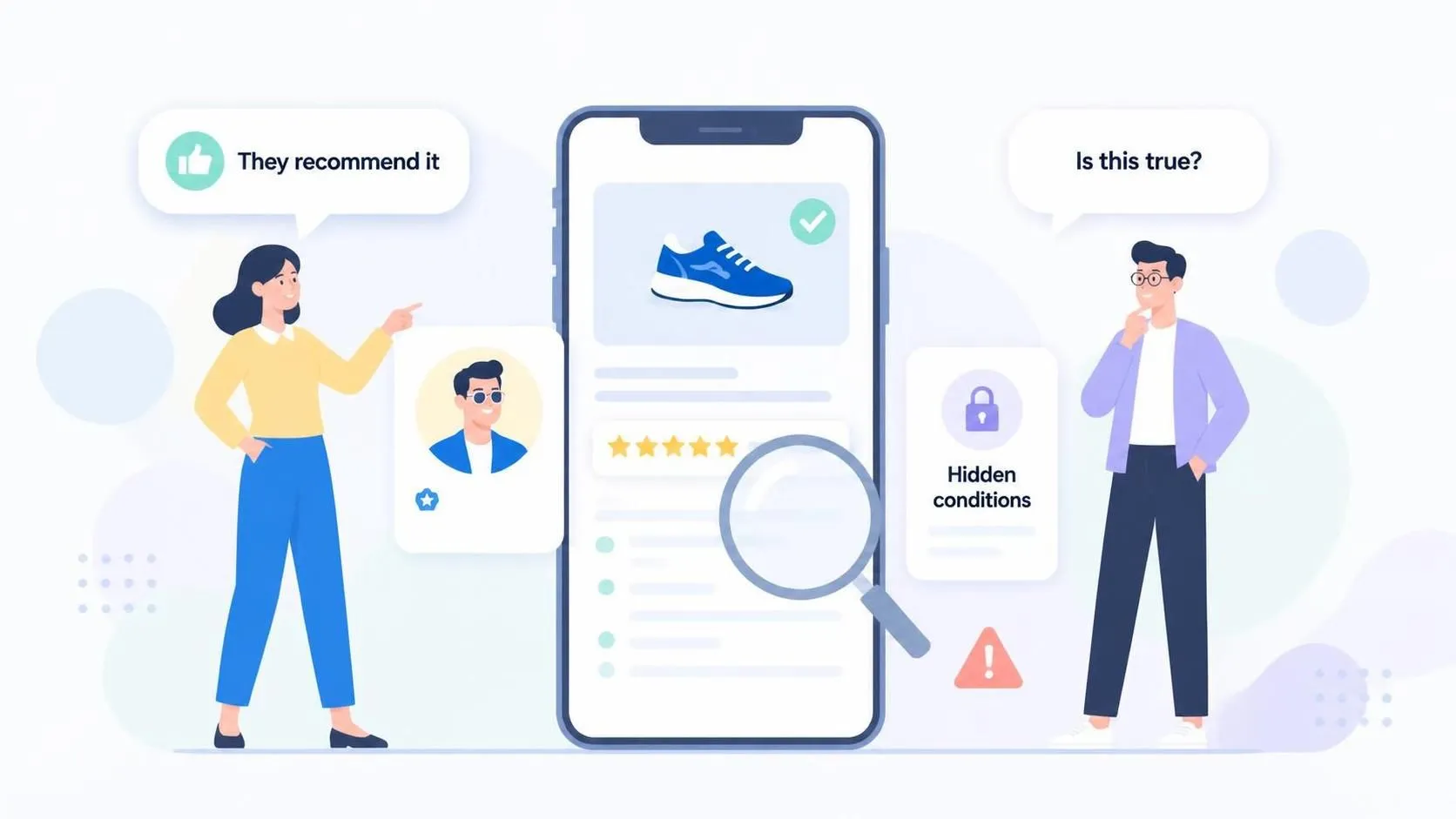
Walk into any app store, scroll a social feed, or pass a billboard and you’ll see the same pattern: ads try to steer you toward a purchase by shaping what you think is true, what feels important, and what information is missing. Some ads do it with bold claims, but others do it with more subtle techniques—especially two that work particularly well because they mimic “normal” reasoning.
Personality-based marketing can occasionally help you discover products you would’ve missed—especially when an influencer genuinely explains what they like and why, and when the claim is grounded in experience. The issue isn’t that personalities exist; it’s when the ad uses them as fake evidence rather than sharing clear, verifiable context.
That's why in this article we will cover two major ways ads mislead: (1) influencer/personality-based recommendations that borrow credibility, and (2) hidden or carefully framed information that makes a statement technically possible while still steering you unfairly.
Personality-Based Recommendations: “If they use it, you should too”
Why this worksInfluencer and celebrity ads often sell more than a product. They sell a story: status, identity, attractiveness, athletic ability, success, or “the life you want.” The ad implies that the personality’s choice is evidence that the product is good—even when the connection is weak.
In practice, the ad’s reasoning can look like this:
- “A famous person (or a respected influencer) uses this.”
- “Therefore, the product must be high quality or effective.”
- “Therefore, you should want it too.”
That chain is emotionally persuasive, but it doesn’t logically follow—especially when you consider how these recommendations are made.
How the manipulation can look
- Celebrity as proof: A soccer player appears endorsing a deodorant, perfume, or shoes. Viewers treat that as a test result.
- “Look who’s wearing it”: Fashion or fragrance ads rely on the idea that style + charisma + the product are connected.
- Influencer “routine”: Skincare or supplements are shown in daily routines, implying the influencer’s personal results are universal.
- Social pressure: Comments and “before/after” visuals create a crowd-effect: if others want it, you should too.
Practical steps to resist the “borrowed credibility”
- A recommendation is not a guarantee. Ask what matches your situation. Different bodies, skin types, hair, climates, and usage habits produce different outcomes.
- If the ad’s main argument is “someone famous uses it,” demand more than branding. Look for:
- specific performance claims (and how they were tested),
- details about ingredients or features
- clear limitations (“results vary,” “works best for X skin type,” etc.).
- Sponsored content isn’t automatically worthless—but it changes what to expect: incentives may reward positivity over truth.
If the ad only shows a lifestyle (perfect skin, perfect hair, flawless confidence), it’s marketing mood, not proof. Evidence could include:
- measurable results,
- consistent explanation of what changed,
- credible comparison (not just “wow it’s amazing”).
- What exactly is the claim? (e.g., odor protection for 48 hours)
- What would I need to be true for that claim to hold? (ingredients, usage method, your body/situation)
If the ad can’t answer those, it’s leaning on your feelings and the personality’s status rather than the product’s reality.
Hidden Info and “Technically True” Claims
Not all misinformation looks like a bold falsehood. Many ads use a tactic like this: they make a statement that could be true, but only under conditions you’re not told.
How the manipulation can look in real advertisingIf I say I bought a car for $100, you might think it’s not true—but it can be true if it was a toy car.
The “toy car” detail changes the meaning of what you’re being led to assume. Companies can defend themselves by saying, “Technically, we didn’t lie.” But you still made a decision based on an incomplete picture.
Ads often hide important qualifiers in ways that are easy to miss:
- “Up to X% off” (the real discount might be smaller for most items)
- “All natural” (what matters is what it’s made of, and what is “natural” enough)
- “Clinically proven” (sometimes meaning: tested in a narrow way, with specific dosing, not necessarily for your exact use)
- “Works instantly” (maybe it works instantly at one stage, not the main outcome)
- “Long-lasting” (the ad doesn’t say what “long” means in realistic conditions)
Practical steps to unmask hidden info
Use these steps the next time you see a confident claim:
- Look for wording like “up to,” “may,” “helps,” “designed for,” “in some cases,” “when used as directed,” and “results vary”—these phrases aren’t automatically bad, but they often signal that the ad may be leaving out crucial details like “how much” you can expect and “for whom.”
- If an ad claims something like “48 hours,” check the fine print: what conditions must be true, which product version it refers to, how often you’re supposed to use it, and how the “48 hours” was measured (who measured it and what method they used).
- When the ad says something like “Up to 50% off,” think: the headline doesn’t guarantee you’ll receive 50% on what you actually want—your discount may depend on the exact product and its current price—so you should check the fine print to confirm the real percentage you’d get for that specific item.
- This is a powerful honesty test. If the value collapses once the missing condition is revealed, you were manipulated by framing.
- The same product can be advertised differently depending on which benefit the ad wants to highlight, so check what’s actually included and how it’s used by reviewing the ingredient list (for cosmetics or supplements) and the full usage instructions, and then look for independent reviews that describe real limitations or downsides—not just enthusiastic praise.
Putting Both Tricks Together
Some ads combine a personality endorsement—like “they use it”—with more technical wording such as “up to,” “when used properly,” and “results vary.” This pairing works because the endorsement builds emotional trust: you’re more likely to believe the claim when someone you find relatable seems genuinely confident. Then the technical language gives the advertiser extra flexibility, so the promise doesn’t have to be as specific or guaranteed as it first appears.
That combo is particularly effective because it lets the claim survive tough questions. If results aren’t as impressive for you, the wording in the fine print can shift the blame to conditions—like how it was used, who it’s intended for, or what kind of outcomes are expected—without the ad ever directly contradicting itself. In other words, the influencer drives belief, while the disclaimers create room for variation, making the overall message harder to evaluate critically.
Ask Questions
Not always. Many are technically defensible while still misleading by omission or framing. The goal is often to shape your interpretation, not to state a fully honest, complete truth.
Ask: "What is the actual claim, and what evidence is provided beyond the person’s status?" If the ad offers mostly lifestyle cues and not performance context, it’s leaning on identity rather than proof.
Use a small routine:
- Identify the main promise.
- Locate the qualifiers (“up to,” “may,” conditions).
- Translate it into what it really means for the exact product you’re considering. If the value depends on hidden conditions, be skeptical.
Treat ads as information with incentives. Look for claims with clear, testable boundaries and details that match your situation. You’ll still find great products—but you’ll demand honesty in presentation.