Veganism is not the problem by itself. The real problem is when people jump into it for the wrong reasons, with no planning, no knowledge, and no backup plan for nutrition.
That happens a lot now. Some people follow social media trends, some want to fit in with friends, some are pushed by short documentaries, and some simply think “vegan = healthy” or “vegan = weight loss.” That mindset is too shallow. A vegan diet can be done well, but it is not automatically balanced just because it removes animal foods.
My main criticism is simple: don’t copy the crowd. If someone chooses veganism, it should be a conscious decision, not a social costume.
Not ideology but impulsiveness
A person can become vegan and still stay healthy if they replace nutrients properly. But many people don’t. They cut meat, fish, eggs, and dairy, then replace them with pasta, snacks, fries, salads, and processed “vegan” products. That is not a smart diet. That is just restriction with branding.
A well-planned vegan diet can work, but some nutrients need special attention, especially vitamin B12, vitamin D, iodine, calcium, iron, zinc, and omega-3 fats. If these are ignored, the diet may look ethical or trendy on the outside while quietly becoming nutritionally weak on the inside. The NHS says a healthy vegan diet can meet needs only with good planning and fortified foods or supplements; otherwise, important nutrients can be missed.
The main risks people ignore- Vitamin B12: This is the biggest one. B12 is not reliably available in unfortified plant foods. If someone becomes vegan and does not supplement B12 or use fortified foods properly, deficiency becomes a real risk. B12 matters for blood and nervous system health.
- Iron: Plant iron exists, but it is absorbed less efficiently than heme iron from meat. That doesn’t mean vegans always become iron-deficient, but it does mean food choices matter more. Pairing iron-rich plant foods with vitamin C helps. B12 matters for blood and nervous system health.
- Calcium and vitamin D: These are important for bones, and they can be harder to get if someone drops dairy and never replaces it with fortified alternatives.
- Omega-3 fats: Flax, chia, hemp, and walnuts help, but the conversion to EPA and DHA is limited.
- Protein quality and total intake: Vegans can get enough protein, but careless eating makes it easier to fall short.
A systematic review found that vegan diets are often lower in protein and several micronutrients of concern, including B12, vitamin D, iodine, calcium, and selenium. It also noted that avoiding nutrient inadequacies can be challenging without planning.
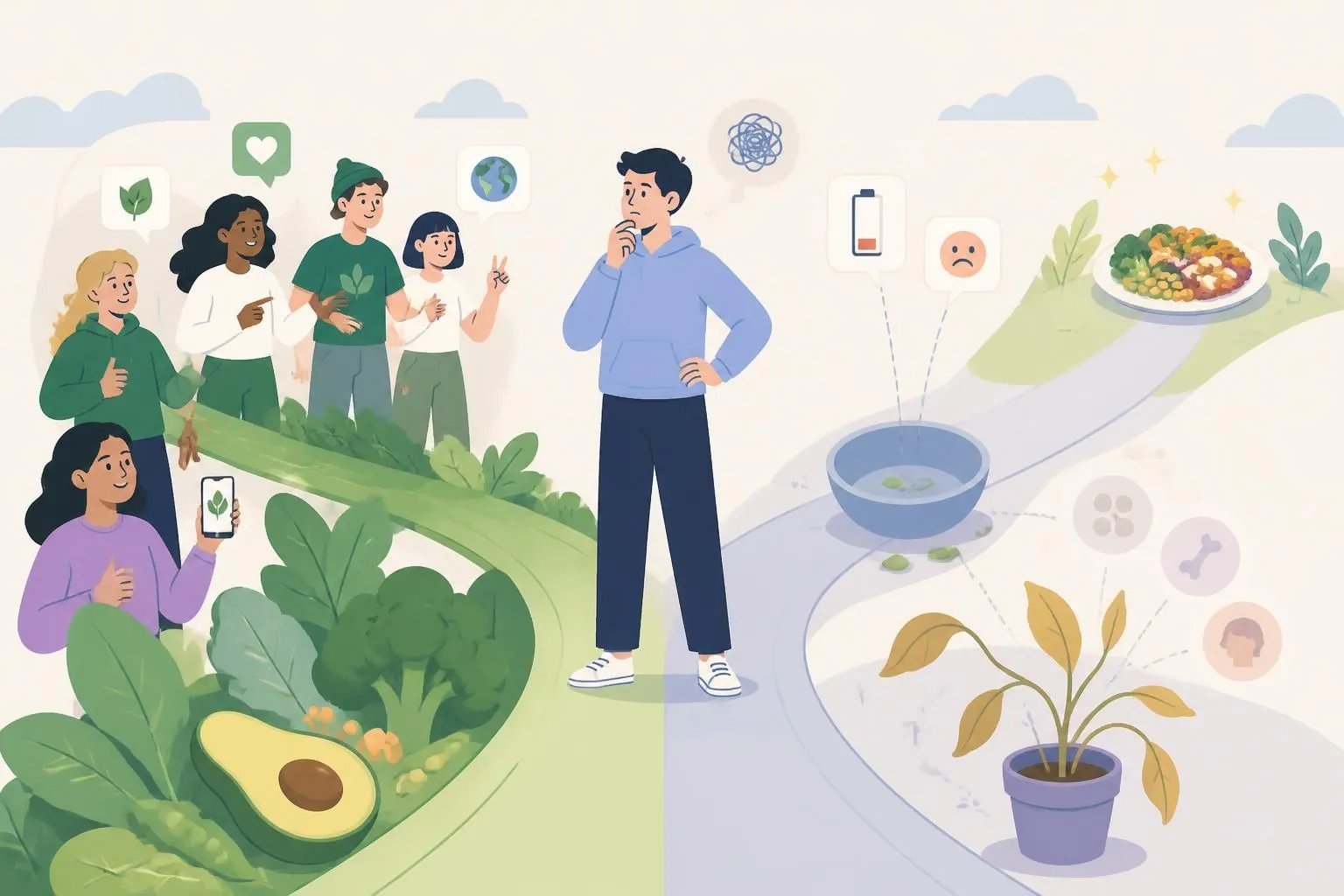
The social-pressure trap
This is the part people don’t like hearing: some people are not choosing veganism, they are outsourcing their judgment.
They see:
- friends doing it,
- influencers praising it,
- environmental content framing meat as morally bad,
- quick “before and after” weight-loss stories,
- short documentaries that simplify everything.
That is risky because motivation based on pressure is unstable. Once the trend fades, the discipline often fades too. Worse, the person may keep the label “vegan” while eating poorly and feeling tired, weak, or frustrated.
I wonder how many people stop to think about how easily environmental messages can shape their food choices. We hear that cows pollute, that meat is harming the planet, and that eating animal products is somehow a selfish habit. And yes, there is a real environmental issue here: livestock, especially beef, can have a much larger climate footprint than plant foods. But we need to be aware of something else too — this topic is often reduced to a slogan. When that happens, people are pushed to make emotional decisions instead of informed ones.
We also need to be careful with the “meat is always bad” idea. It sounds convincing in a short video, but reality is more complicated. Not all meat has the same impact, and not all farming systems are the same. Some emissions can be reduced through better practices, so the issue is not as simple as “eat vegan or you are part of the problem.” I think that nuance matters, because when people only hear the extreme version, they may rush into veganism without understanding what they are giving up nutritionally.
If someone chooses veganism, it should come with planning, not just repetition of someone else's ideas. We need to be aware that cutting meat, fish, eggs, and dairy also means replacing the nutrients they provide — especially B12, but also iron, calcium, iodine, and omega-3 fats. Otherwise, the “ethical” choice can quietly become a nutritional mistake.
The weight-loss myth
Vegan does not mean slimming miracle.
Yes, some people lose weight after switching to a plant-based diet. But that is usually because they eat fewer calories, more fiber, and less processed food. It is not magic. And it is definitely not a reason to become vegan without understanding nutrition.
Research on plant-based interventions often shows weight loss benefits, especially in structured programs, but that does not mean every vegan diet causes healthy weight loss. Some vegan diets are packed with refined carbs, sweets, fried foods, and ultra-processed products. Those can still lead to poor nutrition and unwanted weight changes.
So if the real goal is weight loss, the better question is: how do I eat less junk and more nutrient-dense food? Not: how do I remove animal products and hope for the best?
What a thoughtful vegan approach looks like
A careful vegan diet is built, not guessed.
Good habits that make it workable- Use fortified foods regularly.
- Take B12 seriously every single day or week, depending on the supplement.
- Include protein at every meal.
- Use iodized salt if appropriate.
- Choose calcium-fortified plant milks and calcium-rich foods.
- Add omega-3 sources often.
- legumes: lentils, beans, chickpeas, soy
- fortified plant milks and yogurts
- nuts and seeds
- whole grains
- fruit and vegetables of different colors
- fortified breakfast cereals
Practical steps before going vegan
These steps are designed around the reality that silence is common, so I’m focusing on actions that still protect my time.
- If the answer is “because everyone else is,” stop there and think again.
- Know what B12, iron, calcium, iodine, vitamin D, zinc, protein, and omega-3 actually do.
- Every food group you cut needs a replacement strategy.
- Especially B12. For many vegans, this is non-negotiable.
- If you’re tired, pale, dizzy, losing hair, or eating very selectively, blood work matters.
Ask Questions
No. But it should be a deliberate choice, not a copied identity.
Yes, if it is well planned and supplemented properly.
Cutting animal foods without replacing B12, protein, iron, calcium, iodine, and omega-3 properly.
It can help some people lose weight, but only if the overall diet is controlled. Vegan junk food is still junk food.
If someone truly wants to be vegan, learn the nutrition rules first, then build the diet around them.