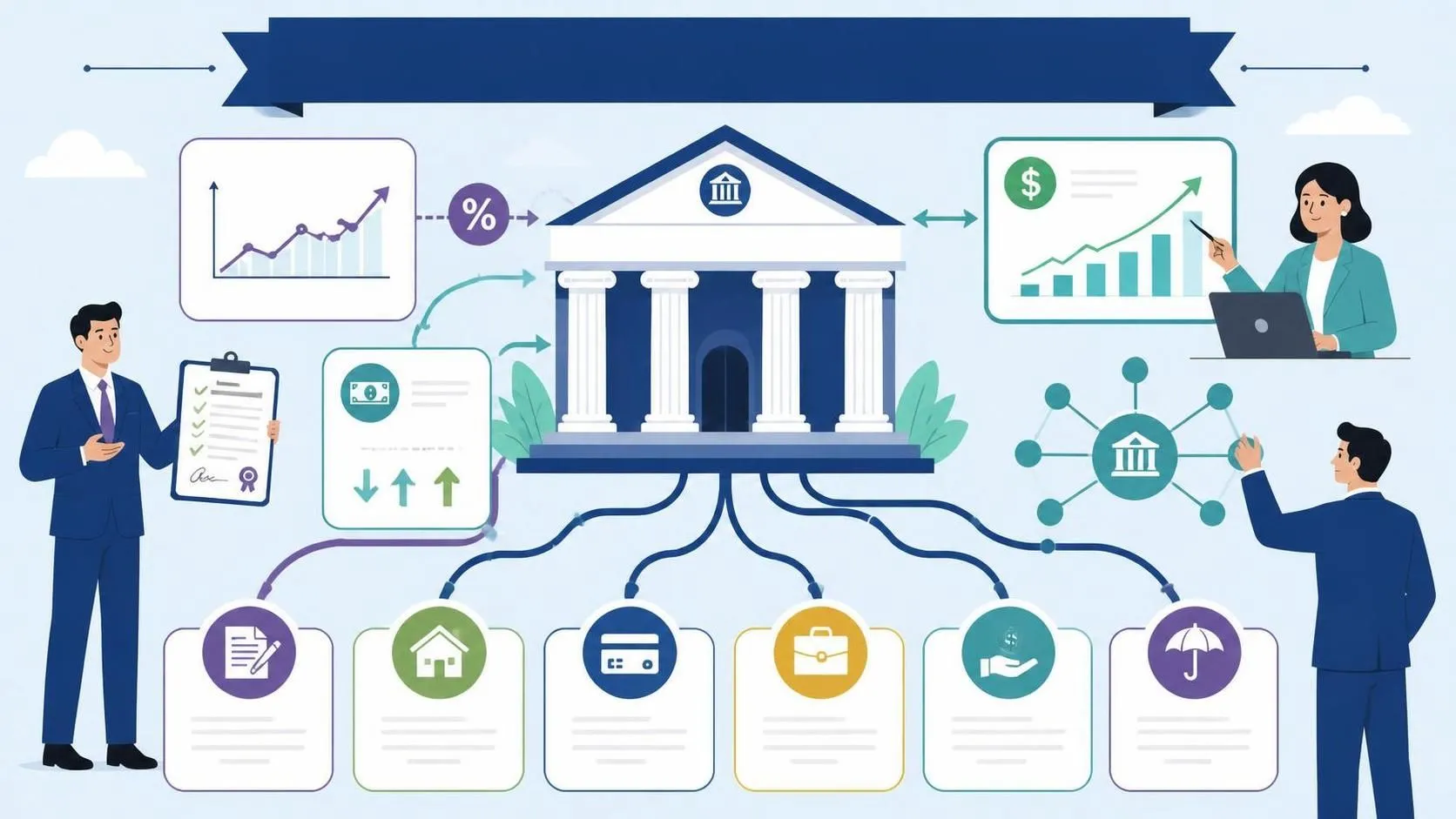
Banks didn't quietly accumulate power—they engineered it. Over the past century, especially since the dismantling of Depression-era safeguards, banks transformed from utilities into empire-building institutions. Here's how they pulled it off:
The Foundation: Regulatory CaptureBanks achieved dominance by essentially hiring the referees. Through lobbying, revolving-door appointments (regulators become bankers; bankers become regulators), and strategic campaign contributions, they've shaped rules in their favor. The 2008 financial crisis taught us this lesson vividly—no meaningful rules changed. Instead, bigger banks bought smaller ones and became even larger.
The Leverage PlayYour $100,000 deposit doesn't sit in a vault. It's immediately lent out—often 10 to 20 times over. This fractional reserve system is legal and works fine when confidence holds. But it means banks operate on razor-thin margins of safety. They're perpetually one crisis away from insolvency, yet they've convinced us this is normal.
Key fact: Modern banks operate with leverage ratios where a 5% decline in asset values can wipe out all equity. Yet they're permitted to do this because "systemic risk" means the government will bail them out. It's socialism for the rich, capitalism for everyone else.
The Fee EmpireBeyond lending, banks monetize every interaction. Overdraft fees ($35 per incident, often stacked), ATM fees, monthly maintenance fees, wire transfer fees, inactivity fees—the list is endless. A poor person with a checking account pays far more in fees (percentage-wise) than a millionaire. It's a regressive tax system banks operate in parallel to the government.
Investment Banking and Trading: The Casino FloorThe real profit center emerged after the repeal of Glass-Steagall (1999). Banks could now use deposits to trade derivatives, securitize loans, and engage in proprietary betting. When these bets paid off, executives got bonuses. When they exploded, depositors and taxpayers absorbed the loss.
The Money Machine: How Banks Actually Make Money (And Why It's So Fragile)
Net Interest Margin (NIM): The Core BusinessA bank borrows from you (pays you 0.01% on savings) and lends to a homebuyer (charges 6.5% on a mortgage). That ~6.5% spread is the net interest margin. It's simple, it's profitable, and it works as long as borrowers repay. In low-rate environments (2010-2021), banks killed it. Deposit rates stayed near zero while loan rates remained elevated.
The trap: When interest rates rise (2022-2025), banks face a squeeze. Your savings account now earns 4-5%, but the mortgages and loans on the bank's books were issued at lower rates. The gap evaporates. Worse,depositors start moving money to high-yield savings accounts elsewhere, forcing banks to raise rates or lose deposits.
Non-Interest Income: Fees, Fees, and More Fees| Revenue Stream | How It Works | Who Pays Most? |
|---|---|---|
| Overdraft fees | Charge $35 when account goes negative; often apply multiple times per day | Low-income account holders |
| Wire transfer fees | $15-50 per wire; international wires can be $50+ | Everyone, but especially those sending remittances |
| Credit card interchange | Banks take 1.5-3% of every transaction merchants process | Ultimately consumers, via higher prices |
| Wealth management | 1-2% annual fee on assets under management for the rich | The wealthy (who have capital to charge fees on) |
| Trading and investment banking | Spreads on trades, IPO underwriting, M&A advisory | Corporations and ultra-high-net-worth individuals |
Banks trade on their own account (proprietary trading) and manage investment portfolios. In boom years, this generates massive profits. In crisis years, these same portfolios blow up. 2008 showed us how a mortgage-backed securities portfolio valued at "safe" could evaporate. 2023 showed us how interest rate changes could crater the value of Treasury holdings overnight (see: Silicon Valley Bank).
Why Banks Are Always on the Brink of Crisis
When the Federal Reserve raised rates from near-zero to 5.5% (2022-2023), banks faced a disaster. They'd locked in years of lending at 3-4% rates. Meanwhile, they had to raise deposit rates to 4-5% to keep customers. The spread evaporated. More painful: the old loans on their books (mortgages, corporate loans) had declined in value. If a bank had to sell them, massive losses. Silicon Valley Bank didn't even have to sell—the market just realized these assets were worthless, and the bank collapsed in March 2023.
Lesson from 2023: SVB had $120 billion in deposits and appeared solvent. Then a news story spooked depositors, who withdrew 25% of deposits in one day. The bank couldn't cover withdrawals without selling underwater securities. Insolvent. In 48 hours, it was seized. This wasn't a slow decay—it was a bank run, the oldest crisis in banking.
Credit Risk: The Borrower Stops PayingBanks make money by lending, but borrowers default. Unemployment spikes, real estate crashes, or a tech bubble pops. Suddenly, loan losses mount. In 2008, mortgage defaults exploded because underwriting had become a joke—loan officers had quotas, not standards. Banks bundled bad mortgages into securities, sold them globally, and walked away. When defaults soared, the entire system nearly collapsed.
Regulatory Capital Standards: Theater, Not SafetyAfter 2008, regulators imposed "capital requirements"—banks must hold a certain percentage of equity relative to risky assets. Sounds good. But here's the trick: banks get to define what's "risky." Treasury bonds? Barely risky. Mortgage-backed securities? Low risk (until they're not). Derivatives and off-balance-sheet vehicles? The banks fought to keep them lightly regulated.
Furthermore, banks hire the smartest mathematicians to game these rules. If regulators say you need 10% capital against mortgages, banks immediately find ways to restructure or re-package mortgages to appear less risky. The Basel accords (international banking standards) are constantly updated because banks exploit loopholes faster than regulators can close them.
Client Money Mishandling: Fraud, Negligence, and Legal Consequences
Between 2002 and 2015, Wells Fargo employees opened over 3.5 million fake accounts in customers' names without their knowledge. Why? Sales quotas. Employees faced "community banker" expectations to cross-sell products (checking, savings, credit cards). Those who couldn't meet targets faced termination. So they invented customers instead.
Customers discovered unauthorized accounts on their credit reports. Some had fraudulent charges. The scandal cost Wells Fargo $3 billion in fines, settlements, and remediation. The bank's CEO paid $65 million in personal penalties and a $23 million clawback of compensation. But here's the infuriating part: the bank is still operating. No executive went to jail. The fines, while large, are trivial relative to the bank's annual profits (~$20 billion). It was the cost of doing business.
LIBOR (London Interbank Offered Rate) is used to price trillions of dollars in loans globally. From 2008-2012, major banks including Barclays, RBS, UBS, and HSBC manipulated LIBOR for profit. Traders would request their colleagues on the LIBOR-fixing panel to submit false rates that benefited the bank's trading positions.
This wasn't a mistake. It was systematic fraud. Millions of borrowers—homeowners, businesses, student loan holders—paid higher interest rates because of rigged benchmarks. The banks paid fines, but the consumers harmed never saw compensation. UBS paid $1.5 billion; Barclays, $450 million. Individual bankers? A few were fined, but prison sentences were rare.
Banks knowingly sold mortgage-backed securities to investors while understanding the underlying mortgages were garbage. Documents later revealed that loan officers had quotas but no vetting standards. Stated-income loans (liar's loans), NINJA loans (no income, no job or assets), adjustable-rate mortgages bundled with fraud—these were packaged, securitized, and sold globally as AAA-rated.
Bank executives and mortgage brokers knew. Internal emails showed awareness. Yet when the crisis hit, only a handful of mid-level traders faced charges. Senior executives who profited millions? Most walked free. The settlements (Bank of America paid $16.65 billion to the Justice Department in 2014) came from bank capital, not from personal assets of the perpetrators. Shareholders and employees bore the cost; the guilty executives kept their bonuses.
Banks have perfected the art of overdraft fees. Here's the game: when your account goes negative, instead of declining the transaction, the bank approves it and charges you $30-35 per overdraft. But it gets worse: banks reorder transactions to maximize overdrafts. A debit card purchase followed by a check might be reversed to process the check first, creating multiple overdrafts instead of one.
In 2023, major banks collectively earned $30+ billion annually in overdraft fees. These fees disproportionately hit low-income account holders who are more likely to experience overdrafts. A single incident ($100 overdraft) can trigger $105+ in fees when transactions are processed in the bank's preferred order. The customer is broke; the bank profits from desperation.
During the 2008 housing crisis, banks needed to foreclose on millions of mortgages. The problem: they'd lose the original mortgage documents during securitization. Solution? "Robo-signing."
Bank employees signed thousands of foreclosure documents per day without reading them, using fake notary seals. Some foreclosed on people who had actually modified their loans successfully.
Families lost homes because of forged documents. Banks claimed incompetence, not fraud. Settlements allowed some borrowers to stay in homes, but the damage was done. And significantly: zero executives faced criminal charges for this systemic forgery.
Conclusion: The Game Never Ends
Banks are empires built on a simple asymmetry: they borrow at low rates and lend at high rates, pocketing the difference. They leverage this spread 10-20 times over, amplifying returns on equity. This works beautifully during calm periods. But the system is inherently fragile—it requires constant confidence, favorable interest rates, and borrower solvency simultaneously. When any of these fails, the dominoes fall.
The real genius of modern banking isn't in lending prudently; it's in capturing regulatory capture, lobbying for lighter oversight, and socializing losses when the inevitable crisis arrives. When SVB collapsed in 2023, depositors were made whole by the government within hours. Yet when ordinary homeowners default, foreclosures proceed. The asymmetry is baked in.
The mishandling of client money—fake accounts, LIBOR manipulation, robo-signing, overdraft abuse—reveals the core problem: banks face minimal consequences for crimes that ordinary citizens would face jail time for. The fines are theater. Executives retire with golden parachutes. Shareholders absorb costs. Clients rarely see justice.
Until the law treats banking fraud the same way it treats other fraud—with jail time, asset seizure, and personal liability—the scandals will repeat. The next crisis is already being built. The only question is when confidence breaks and who pays the bill.
Ask Questions
No—it's applied within each province (constituency) before D’Hondt.
It gets excluded from D’Hondt in that province, meaning it can’t win any seats there.
Yes. Blank votes are counted as valid votes for calculating the threshold, which can make the 3% gate harder for smaller parties.